
The 2027 Sea-Doo Lineup: What Actually Changed (Not Just the Colours)
BRP dropped the 2027 Sea-Doo lineup on August 17, and within hours every PWC site online was running the same three facts: more horsepower, a new Spark, and a limited-edition Senna model in the same yellow-and-green as Ayrton Senna’s famous helmet colours. All true. None of it really tells you what actually changed on the machines.
I’ve been in Sea-Doo engine bays for 25 years, and the interesting part of a model year update was never the paint or the graphics. It’s what BRP quietly redesigns underneath — the stuff that determines whether a 2027 is a genuinely different machine to service and own, or just last year’s ski with a new sticker kit.
Short answer: 2027 is a real engineering update across most of the range, not a cosmetic refresh. The 350hp platform gets there through a bigger supercharger impeller, not just a tune — I honestly expected a tune to get it to 350. The entire electrical architecture is moving from the old ME17 ECM to the newer XCU generation across GTX, GTR-X and Spark, which also kills off the camshaft position sensor on several engines. The Spark gets a genuinely new engine, hull, pump and reverse system. And there’s a string of bearing, piston and cooling-clamp changes across the 1630 platform that read like BRP addressing real-world reliability points, not marketing bullet points.
The horsepower number everyone’s reporting — here’s how they actually got there
RXT-X 350, RXP-X 350, the RXP-X Senna 350, and GTX Limited 350 all move to the new 1630 SXHO+ engine. Every outlet is repeating “350hp” without explaining the mechanism, so here it is: the supercharger gets a larger compressor wheel, now pushing a stated 17+ PSI at 8,500rpm, and the rev ceiling is up to match. There’s also a new intake grate and jet pump housing aimed at acceleration response, and a modified ride plate. That’s the real source of the extra output over the outgoing 325hp SXHO unit: a bigger blower moving more air, stronger internals to take it, and pump/intake work to put it to the water — not just a software remap.
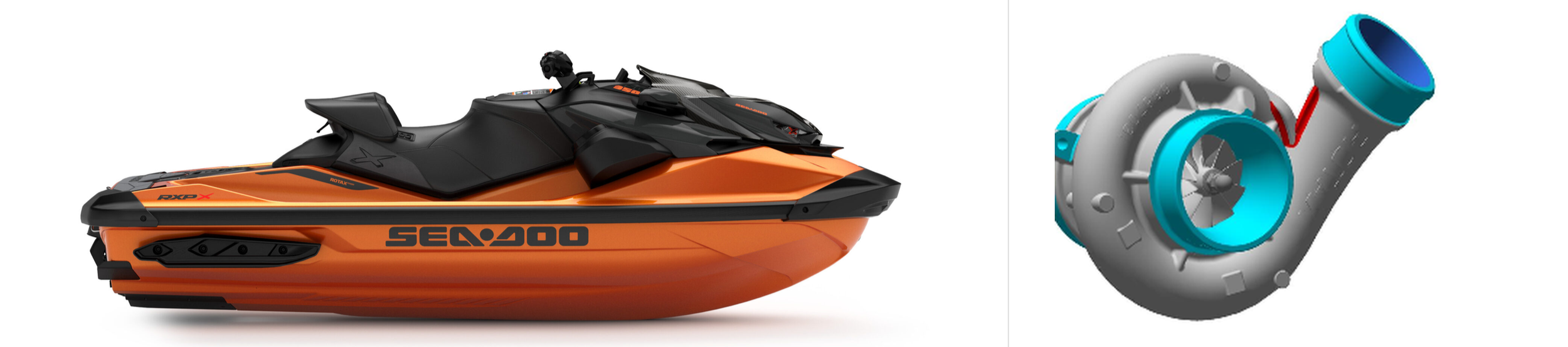
RXPX 350 and upgraded New 350hp supercharger render
Correction worth flagging: a couple of articles floating around have claimed the GTX Limited doesn’t get the IDF reverse system in its 350hp configuration. That’s not correct — confirmed directly with senior BRP technical staff, and it’s also listed on the official website and spec sheet download for the GTX Limited models.
Hardware updates worth knowing if you’re comparing model years:
New pistons, rings and conrod design — a new manufacturer for BRP, with a low-friction coating on the piston skirts.
Head bolts change from a 12-sided bolt head to a Torx E14 head — retrofittable to earlier units if you’re doing head work on an older 325.
Driveshaft thickness increased to suit the 350 application — not retrofittable, so don’t assume 325 and 350 driveline parts are interchangeable.
Ride plate gets additional mounting points — again, not a bolt-on to older hulls. Looking at the parts diagram, there are two more bolts added to the front of the plate to mount it to the hull.
New impeller (pitch change for the extra horsepower) and updated impeller/stator housings.
Pro tip: if you’re shopping a used 2025/26 RXT-X or RXP-X and the seller says it’s “basically the same engine as the new 350,” it isn’t. The block architecture is related, but the supercharger, driveshaft and ride plate are all 350-specific parts. Don’t pay 2027 money for a 325.
The RXP-X Senna 350 — what’s actually different beyond the colour scheme
This one wasn’t on the bingo card for 2027, and as a huge F1 fan I was genuinely impressed when the cover came off it. The Senna edition is limited to exactly 1,991 units worldwide — a nod to 1991, the year Ayrton Senna won the third of his three Formula 1 world titles (1988, 1990, 1991), which are etched into the footwell mats.
Beyond the livery, the Senna runs the same new 1630 SXHO+ 350hp engine as the standard RXP-X, plus:
Custom colourway, decals and engraved footwellmats — Senna logo, signature, and title years.
Platinum 80W audio system, exclusively coloured to match the edition. The 80W upgrade is available on certain models, or as a separate purchase — but only in red.
A centre boost gauge on the cluster — unique to the Senna, not available on other 350hp units.
Customised passenger seat and matching storage cover, specific to this edition, plus a rear seat extension that’s normally a paid option on the standard RXP-X.
“Limited Edition Senna 1 of 1991” badge on the handlebar pad, paired with the signature detail on the rear mat. Worth flagging: from what I’ve heard, every unit carries the same “1 of 1991” wording rather than being individually serialised to its own number in the run — so don’t expect to request a specific number matched to your unit. I haven’t got that confirmed from BRP directly, so treat it as likely rather than certain until it is.
Note for owners: BRP has flagged that unit-specific Senna parts can’t be ordered without proof of ownership and damage — a limitation-badge control to stop replica builds. If you’re chasing Senna-specific parts down the track, expect that verification step.
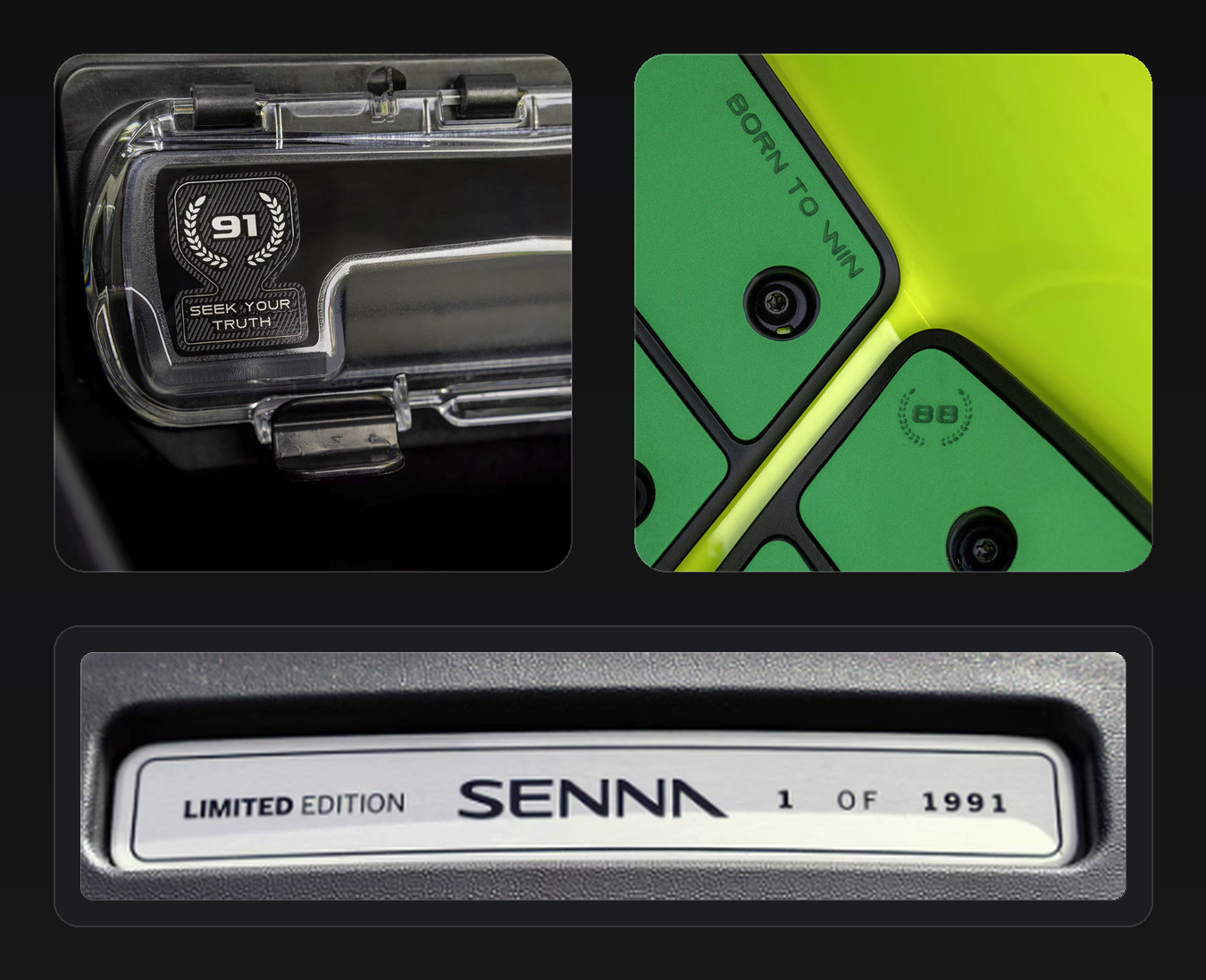
RXPX Senna Edition 350hp limited features
The Spark isn’t a facelift — it’s a whole new, overdue package
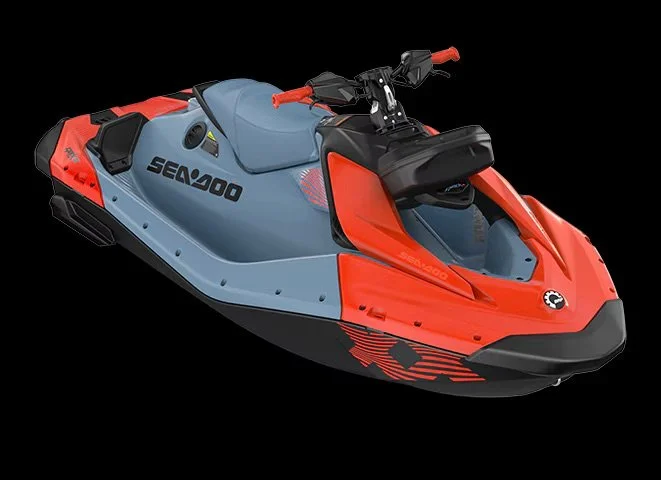
2027 Spark Trixx with coloured centre deck
If you’ve written the Spark off as “the cheap one that hasn’t changed,” 2027 is worth a second look. It gets a new engine, new hull, and an upgraded jet pump across every variant, including new sponsons for improved dynamics — plus a fair bit more. It’s also not quite the budget option it used to be if you want the top-of-the-line model:
New engine and internals — bumped from 900cc to 1000cc, with a substantial overhaul: pistons just under 1mm larger, upgraded piston pins, conrods 2mm shorter but wider to suit the new, wider big-end bearings, and wider main bearings to handle the extra output. Oil pump size is up for better engine lubrication, the cylinder head has been reworked with larger valves and larger intake/exhaust ports, and there’s a new intake manifold, throttle body, spark plugs and ignition coils to match. The cam position sensor is gone too — the same story we’re seeing roll out across the whole Sea-Doo range. Worth noting: it’s not a brand-new engine architecture for BRP — a variant of this 1000cc unit showed up in the new Can-Am HD11 Defender last year — but this package runs much more aggressive timing and an 8,500rpm rev limit.
New pump design — the wear ring is now integrated into the pump housing, the same design language as the bigger 1630 units. Previous Sparks used a simpler, less reliable arrangement.
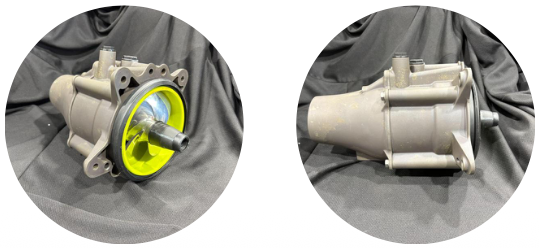
New 2027 Spark jet pump
New driveshaft and floating ring — the floating ring now uses a lock nut and washer, matching the 325/350 units rather than the old c-clip setup.
New intake grate and ride plate — a winged intake grate feeding water more efficiently into the pump tunnel, and a ride plate reworked to accommodate the other pump-area changes.
New IDF (“Intelligent Debris-Free”) system on the 110hp Trixx units — cue a collective groan from the workshop. The new IDF design on the Spark replaces the dog engagement found on the 1630 engines with an inner spline drive, specifically to improve switching behaviour. We’ll see how it holds up. Worth noting: the PTO housings appear to be interchangeable, so removing the IDF setup on the 110hp models doesn’t look especially involved — though sourcing the correct matching driveshaft might be the harder part.
New ECM and harnesses to suit — Sea-Doo completes the transition of its whole model range to the new XCU ECU, with all Spark models moving to it from 2027 on. That means an updated harness throughout the ski, and it also brings active DESS security as standard on Trixx and Convenience models (base models can still be upgraded if wanted).
The bigger story: BRP is retiring the old ECM architecture
The last of the ME17 ECMs have been removed from the remaining models — Spark and the 300hp range — which means a full electronics upgrade: most of the electrical harnesses and the DESS post get the same refresh, on top of what’s covered above for the Spark specifically.
The same XCU migration is also why the camshaft position sensor disappears entirely on the 1000 ACE Spark engine and on the 1630 XHO 300 — the newer ECU generation doesn’t need it, and BRP has replaced the sensor location with a simple cover and O-ring. One less sensor to fail, one less connector to corrode. That’s a genuine reliability upgrade dressed up as a spec sheet footnote.
GTR-X, GTX 300 and GTX 170/230: going big-screen
(Maybe not everywhere — international markets may still end up with the smaller cluster.)
Everyone’s covered the new 10.25” touchscreen cluster with handlebar controls — it looks good, and on the GTX/GTR-X audio variants it now runs the sound system through the same interface. Fine. What’s not being reported is that the cluster swap forces a rebuild of the entire electrical backbone around it: new ECM, new main harness, new steering harness, new audio wiring and enclosure where fitted. If you’re pricing electrical work on a 2027 GTX against a 2026, don’t expect parts interchangeability — this is effectively a new electrical platform wearing a familiar hull.
The HUB cluster across the range also picks up an individually selectable units menu (speed and temp can now be set independently, metric or imperial), and the iBR malfunction message has been reworded from the cryptic “iBR module error” to a plain-language “Braking system malfunction — Brake, Reverse and Neutral are not available, service required” on the touchscreen units. Small thing, but it means fewer confused customers ringing the workshop asking what an iBR error even means.
Quiet reliability changes across the 1630 platform
A few changes apply across the whole 1630 engine family (GTX, GTR, RXT, RXP, Explorer Pro) regardless of output level, and these read like BRP responding to real service data rather than chasing a spec sheet:
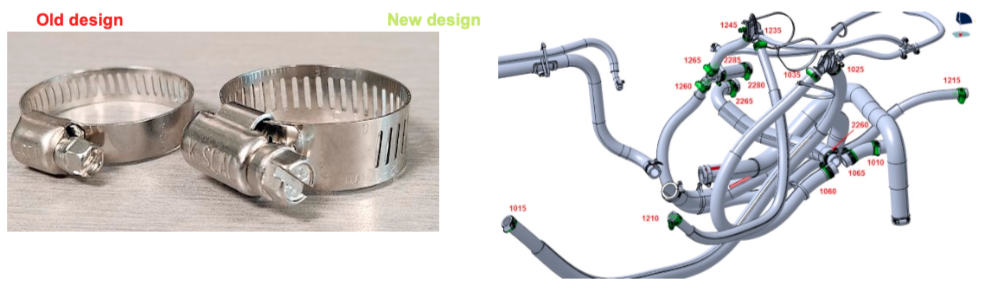
Cooling hose clamp upgrade for 2027
Larger hose clamps on the open cooling system (all models except Spark) — a heavier-duty clamp replacing the older, lighter-gauge band. A welcome upgrade — hopefully they also come through tight from the factory.
New crankshaft and conrod plain bearings — lead-free material, increased radial play, and updated service limits. These are retrofittable, and the service limit numbers change (radial clearance moving from 0.07mm to 0.08mm on the crank, for example) — worth knowing if you’re measuring against an old spec sheet during a rebuild.
New valve spring set with an improved retainer — this was actually a running change partway through MY26, now standardised for MY27. Retrofittable.
New piston and piston ring design across the whole 1630 range, including a running-in coating on the piston skirt. BRP has flagged that this will affect service limits and ring gaps, with a service bulletin to follow for identification. Note: don’t mix old and new ring designs with the wrong piston generation — check the parts catalogue before you assemble, not after.
New crankshaft timing gear and cover with no CAPS trigger pin — tied to the same ECU generation change discussed above. Not retrofittable, but BRP says the old-style service engines remain usable across MY26/27 builds that never had CAPS to begin with, so this isn’t a trap for existing stock.
None of this is flashy. All of it matters more to how long these engines last than the horsepower number does.
GTI, Wake, FishPro, Explorer Pro: the quiet corner of the lineup
If you’re after a straightforward recreation or fishing ski, 2027 is a much smaller story. GTI 130 and GTI SE 130/170, Wake 170 and Wake Pro 230, GTX Pro, FishPro Sport and Trophy, and the Explorer Pro 170/230 carry over largely unchanged mechanically — colour and trim updates aside.
The BRP logo, again
New 3D black-and-white BRP logo for Spark models — the fourth or fifth version change to the front logo decal since the early 2020s. Premium units get the glossy 3D black logo that debuted on the RXP-X Apex.
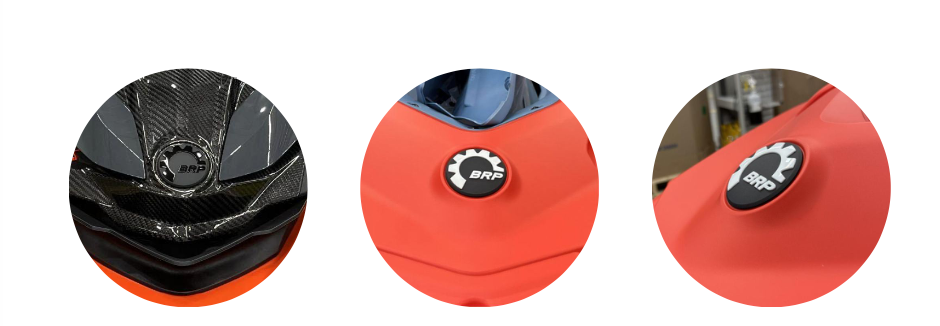
New BRP logo Decal 2027
Who didn’t make the class of 2027
FishPro Scout has been discontinued for 2027, leaving FishPro Sport and Trophy as the two fishing-focused models going forward. Poor sales and growing demand for a larger, more stable fishing platform reportedly led to the Scout being quietly cut from the lineup.
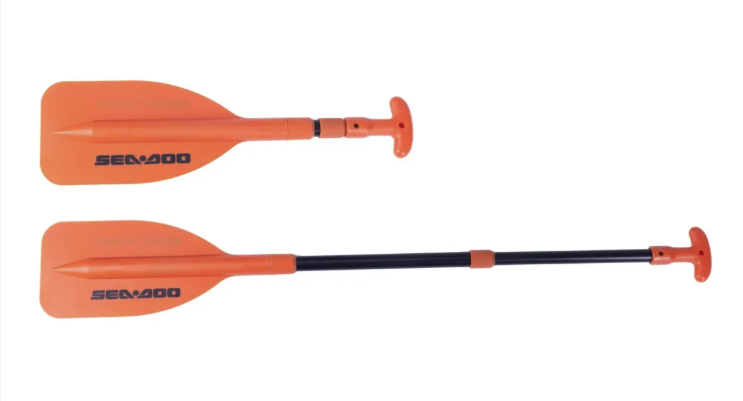
P.S. — buried in the tech release: Sea-Doo also quietly dropped a new collapsible paddle for 2027. High-vis orange, versatile T-handle that doubles as a docking hook. Handy. Also a little concerning that we still need one.
What this means if you’re buying
If you’re cross-shopping a leftover 2026 against a new 2027, the honest answer depends on which model:
GTI, Wake, GTX Pro, FishPro, Explorer Pro — the 2027 changes are mostly cosmetic. A discounted 2026 is a legitimate option here.
GTR-X 300, GTX 300, GTX 170/230 — the electrical architecture is genuinely new. If display, connectivity or audio integration matters to you, or you’re planning to keep the ski a decade and want the newer ECM generation for long-term parts support, that’s a real reason to pay for 2027.
RXT-X, RXP-X, GTX Limited (350hp models) — the biggest genuine upgrade in the range. The bigger supercharger, revised driveline and updated engine internals mean this isn’t the same engine wearing a new number.
Spark — worth serious consideration if you’ve been put off previous Sparks by debris fouling the reverse engagement. The new IDF system on the 110hp Trixx targets that specific complaint, alongside a new hull and pump.
Quick Answers
Is the 2027 Sea-Doo 350 the same engine as the 2026325? No. It shares the same 1630 architecture but runs a larger supercharger compressor wheel for the extra output, plus a different driveshaft and ride plate to suit. They’re not interchangeable.
Does the GTX Limited 350 come with the IDF reverse system? Yes — confirmed with BRP technical staff and on BRP’s own spec sheet, despite some reports claiming otherwise.
Can I retrofit the new 10.25” touchscreen to an older Sea-Doo? No. The cluster upgrade needs the new ECM, harness and steering harness as a package — it’s not a bolt-on accessory.
Does the RXP-X Senna have any performance difference from a standard RXP-X 350? No — same 1630 SXHO+ 350hp engine. The differences are the audio system, boost gauge, seat, storage cover and limited-edition detailing.
Has the FishPro Scout been discontinued? Yes — for 2027 the FishPro line is Sport and Trophy only.
Going Further
Buying secondhand instead of chasing the new model year? The mechanical detail above is exactly what separates a good used Sea-Doo from an expensive mistake — engine generation, driveline compatibility, and knowing what’s genuinely new versus what’s just a different colour. That’s the kind of thing we go through properly in the Used Sea-Doo Buyer’s Guide course.
Related Articles
Used Sea-Doo Buyer’s Guide
Sea-Doo Fault Codes Explained
How Many Hours Is Too Many on a Sea-Doo?