
Sea-Doo DESS Key Explained: Programming, Problems & Replacement
If your Sea-Doo isn't starting, the DESS key is often the first thing to check — and the most misunderstood part of the whole system. This article covers exactly what DESS is, how it works, and what to do when something goes wrong.
Whether you've just bought your first Sea-Doo or you've owned one for years and hit a problem, this covers everything you need to know.
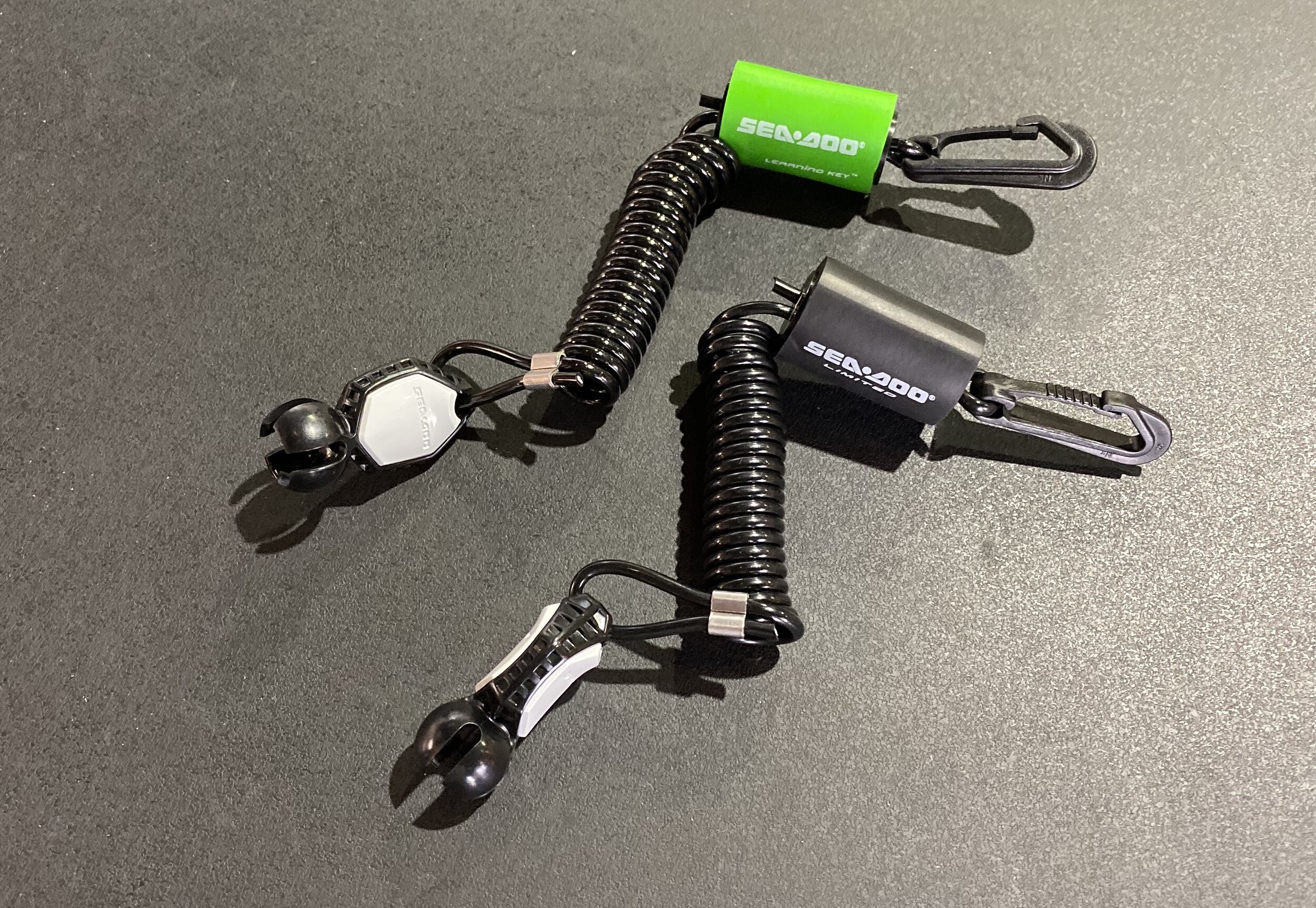
New claw-style Sea-Doo DESS keys became the standard for all Sea-Doo models from 2015 on
What Is a DESS Key?
DESS stands for Digital Encoded Security System. It's Sea-Doo's combined safety lanyard and anti-theft system, and it's been standard on almost every Sea-Doo model since the mid-1990s.
Every DESS key contains two things: an RF chip with a unique digital code, and a magnet. The chip handles security — only a key that's been programmed to your ski's ECU will allow it to start. The magnet is the kill switch — if you're thrown off a running ski and the key yanks free of the DESS post, the engine shuts down immediately.
It's a simple system that does two important jobs at once. Once you understand how it works, most DESS problems become straightforward to diagnose.
Two Key Styles: Drum and Claw
Sea-Doo has used two physical key designs over the years. They're not interchangeable — you can't put a claw key on a drum-style post or vice versa.
The DESS post (the connector on the ski) changed at the same time — 2015+ models use a ball-shaped post to match the claw key. Both components need to match for the system to work.

Drum-style Sea-Doo DESS key was the standard from the mid-90s through to 2015.

Claw style SeaDoo DESS Key and ball DESS post introduced in 2014 on the SeaDoo Spark as a non DESS versions and all other SeaDoo models in 2015 with DESS.
How Many Keys Does a Sea-Doo Come With?
New Sea-Doos from 2019 are supplied with 1 DESS key. More keys are available to purchase and can be programmed to you ski. It it recommended that you have a spare key programmed to your ski as a misplaced or broken key will not allow you to start your Sea Doo. The ECU supports eight to ten individually programmed keys in total depending on year. There's no limit to how many different skis a single key can be programmed to — though in practice this doesn't come up much outside of rental operations.
Normal, Learner and Rental Keys: What's the Difference?
All DESS keys are identical — the colour of the float is the only visual difference (yellow, black, green, orange). The key type is set during programming, not built into the hardware of the key. Any colour key can be programmed as Normal, Learner, or Rental.
STANDARD KEY: Allows full RPM, full speed, and Sports mode to be activated if selected once the ski is running
LEARNING KEY: Limits top speed via GPS, selected when the key is programmed to the ECU (5 levels from 52 km/h to 80 km/h)
RENTAL KEY: Limits top speed via GPS, selected when the key is programmed to the ECU (higher speeds than Learning key settings)
Sea-Doo Spark: The Exception
The Sea-Doo Spark uses a non-DESS key. It looks identical to a claw-style DESS key but has no RF chip inside — just the magnet for the kill switch.
This means any key, or even just a magnet held to the post, will start a Sea-Doo Spark. There is no electronic security on a standard Spark.
You can retrofit DESS to a Spark, but it requires a different wiring harness and keys — it's not a simple swap. Most owners don't bother.
DESS Key Programming: What You Need to Know
Buying a new DESS key and expecting it to work straight away is one of the most common mistakes new owners make. A DESS key does nothing until it's programmed to your ski's ECU — the chip code has to be registered.
What programming requires
Your ski and the new key physically present at the same time
A Sea-Doo BUDS (Bombardier Utility Diagnostic Software) diagnostic computer, or suitable aftermarket software such as RIVA MAPTUNER — the same tool used for servicing and fault code reading
Deactivating DESS
DESS can be fully deactivated on any 4-stroke Sea-Doo. With DESS off, any key — or even a magnet on the post — will start the ski. The lanyard still works as a kill switch, but there's no electronic security.
This is mainly used by rental operators and emergency services managing multiple skis. It's done through BUDS and takes about two minutes.
Lost Your Only Key? Here's What Happens
Losing your only programmed DESS key is more disruptive than it sounds. The ski won't start without it, and you can't just order a replacement that works out of the box.
The process: take the ski to a workshop with BUDS or arrange to have a mobile mechanic to come out to youyourski, purchase a new key, and have it programmed. The old key can be removed from the ECU's memory at the same time if needed. If you've lost all keys and need to wipe the keys recorded in the ECU and start fresh, that's also done through BUDS — it's not a catastrophe, just a workshop job.
Tip: Get a second key programmed as a backup before you ever need it. It takes five minutes while your ski is already in for a service.
DESS Key Troubleshooting: What the Beeps Mean
The DESS system communicates through beeps and dash warnings. Most problems come down to three causes: dead battery, unregistered key, or a faulty DESS post. Here's how to read what the ski is telling you.
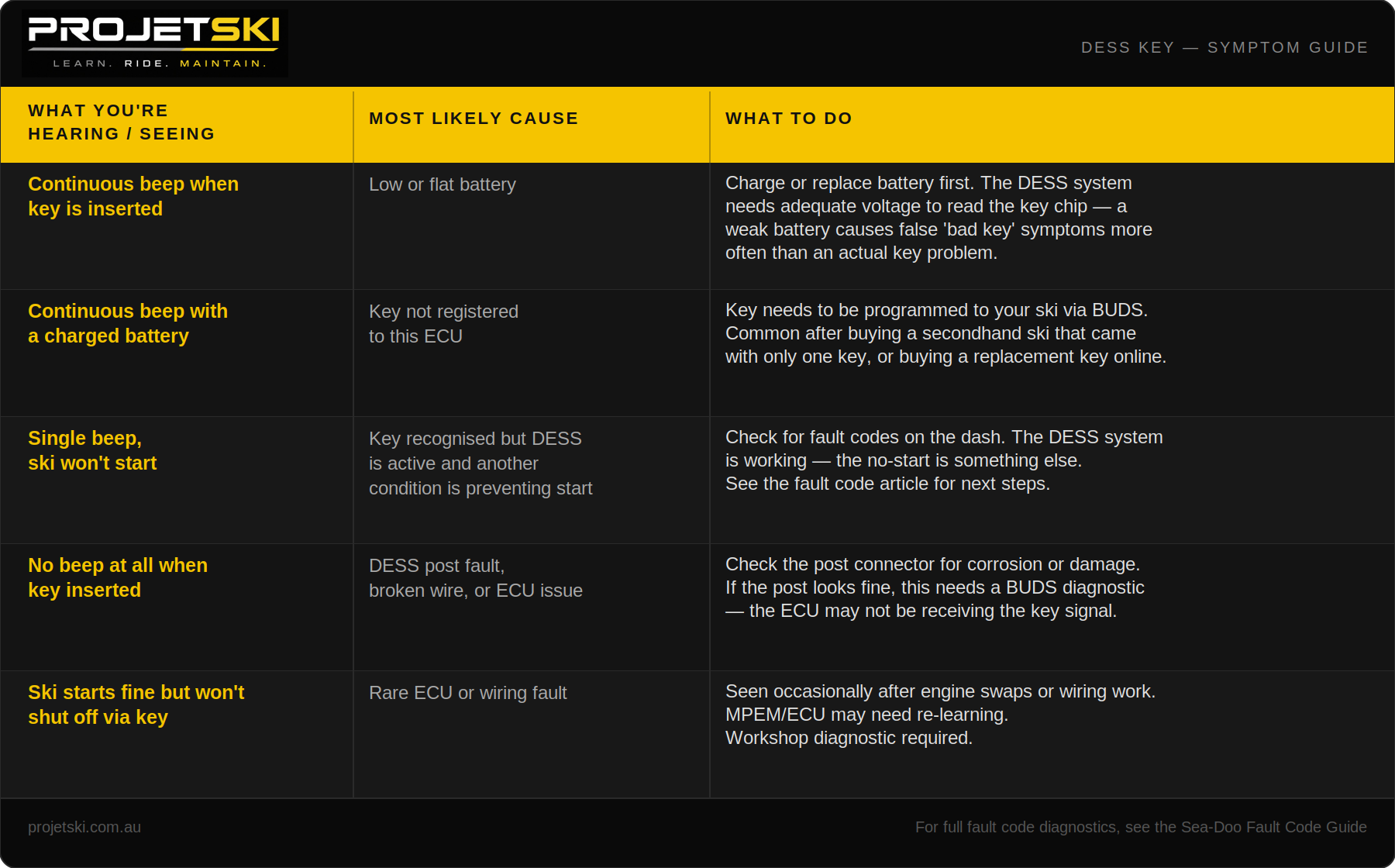
Always check the battery first. A battery below about 12V at rest — or one that drops significantly under cranking load — will cause DESS problems that look like a faulty key and customers will usually see a “READING KEY” fault displayed across the info dash. It's the most common misdiagnosis we see.
Quick Reference Summary
DESS = Digital Encoded Security System. RF chip (security) + magnet (kill switch)
Drum keys: mid-90s to 2014. Claw keys: 2015 onwards. Not interchangeable
Sea-Doo Spark uses a non-DESS key — no electronic security
8 to 10 keys can be programmed to one ski's ECU (depending on year)
Programming requires BUDS or aftermarket diagnostic software — not a DIY job without this
DESS can be deactivated on any 4-stroke via BUDS
Continuous beep = check battery first, then check key registration
Losing all keys isn't catastrophic — ECU can be wiped and new keys programmed