
Which Battery Should You Actually Buy for Your Sea-Doo? (What We Know Works vs What Gets Argued About Online)
By Matt Elliott · Pro Jetski · 2026
Go looking for a straight answer on which battery to put in your Sea-Doo and you’ll find the same thread repeated in every owners’ group: someone asks, a dozen people name a different brand, nobody says how long theirs actually lasted, and the post disappears. I’ve watched this exact conversation happen more than once, word for word, with people specifically asking for links and real answers because the last four times nobody gave any.
So here’s a straight answer, built from what actually fails in the field rather than what gets argued about in comment sections.
Why We Default to AGM
AGM is the right default for almost every owner. In my workshop we sell and install more than 1000 batteries a year — all AGM. If a customer specifically wants a lithium battery fitted, we recommend against it, and only fit one if they insist and supply it themselves. More often than not, we end up pulling it back out for free a few weeks later when they come back with a string of fault codes — that’s the outcome roughly nine times out of ten.
Lithium does have a place on a jet ski: an isolated accessory circuit, like a trolling motor running its own separate charging system, is one setup where it earns its keep. As the main battery running your ski’s electronics, we don’t recommend it — more on why further down.
Why This Question Never Gets a Straight Answer
Part of the problem is that battery life depends far more on how it’s treated than what’s printed on the case. A cheap AGM battery that’s kept charged and disconnected over winter will outlast an expensive one that’s left half-flat on a boat at a marina for three months. So when someone asks “which battery is best” and gets ten different brand names back, all ten people are telling the truth about their own experience — they’re just not accounting for how differently they treat their batteries.
That’s the piece worth separating out: chemistry first, habits second. Get both right and the brand stops mattering much.
As we cover in the fault codes article, a flat or low battery is one of the most common reasons for a no-start or a dash full of fault codes. What a lot of owners don’t realise is that a battery drains over time even when it isn’t being used. A car gets cycled and topped up every time you drive it; a ski can sit for weeks or months between rides. Heat makes this worse — it roughly doubles the rate of self-discharge — and any component with a direct, constant connection to the battery adds a small parasitic draw on top. The older and more depleted a battery gets, the faster this cycle compounds. A ski that’s ridden more often, or a battery that’s kept on a tender between rides, will last significantly longer than one left to just sit.
The Sea-Doo Battery Downsize
2015 was the last model year for the larger 30Ah battery. From 2016 onward, Sea-Doo moved to a smaller 18-20Ah unit with lower cold-cranking amps — most likely a space-driven decision in the newer hulls. But nearly every model year since has added more electrical load on top of a smaller battery: electric throttle body, electronic brake system, colour dash, audio, GPS, extra sensors. Smaller battery, bigger job — which is exactly why keeping it in good condition matters more on newer models than it used to.
What Actually Kills Sea-Doo Batteries Early
In order of how often I actually see it:
Undercharging between rides — short trips followed by storage never fully top the battery back up, and it slowly sulfates over a season.
Leaving the key on the DESS post while stored, or leaving the ski in accessory mode with the dash and accessories powered up.
Corrosion at the terminals from salt air, even when the ski itself hasn’t been near salt water — common for anyone storing near the coast.
Loose battery terminals — poor contact while running stops the battery recharging properly.
Letting it sit fully flat for an extended off-season without a maintenance charge — the single fastest way to permanently reduce a battery’s capacity.
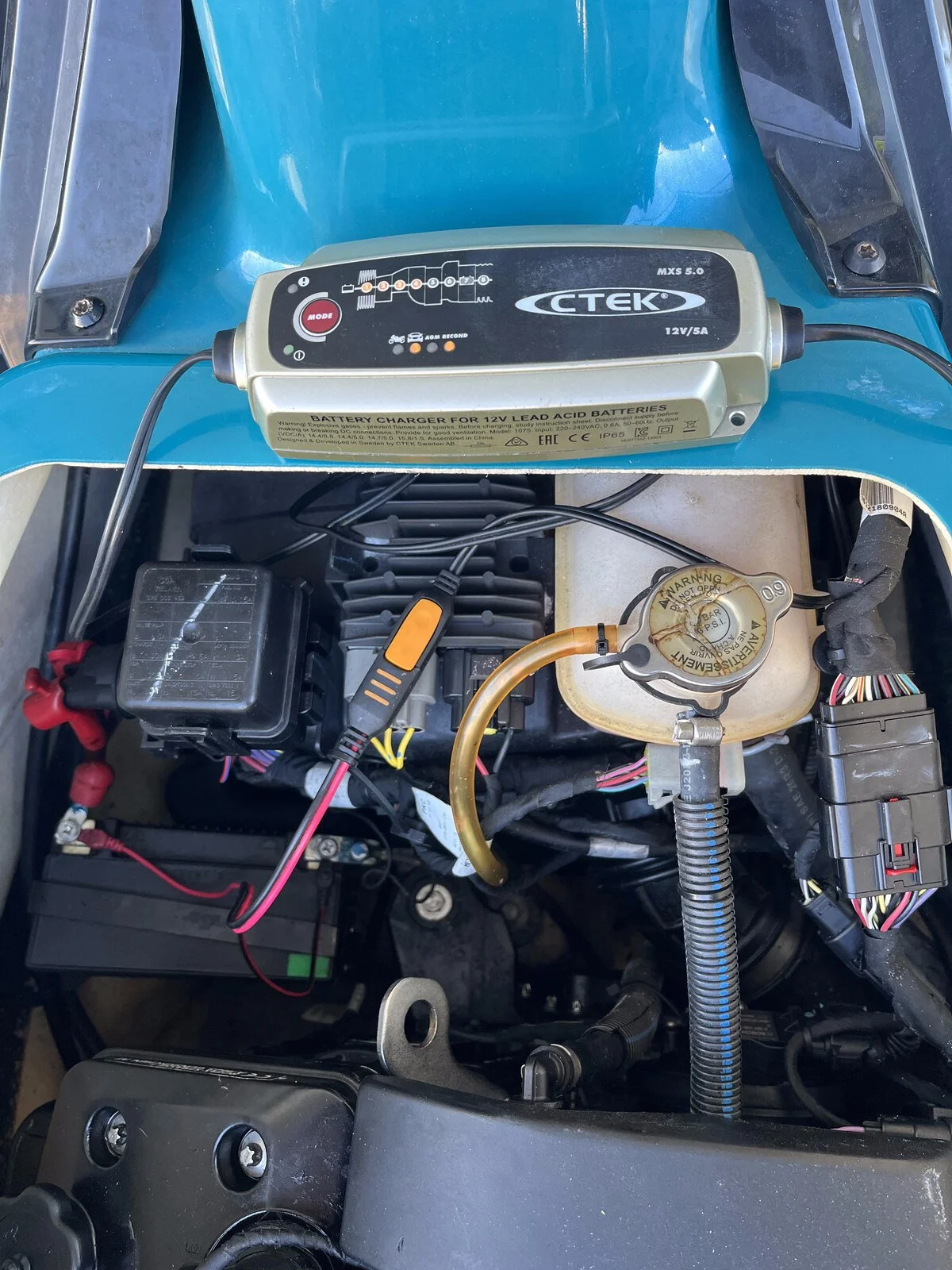
The fix for most of this is a battery tender — not a standard charger left running, but a smart charger built to stay connected long-term. It counteracts the small, constant power draw that modern components and security systems pull even when the ski’s parked, and it uses internal circuitry to check voltage and shift automatically between active charging and a low-current maintenance mode, instead of just pushing current in continuously. That’s what stops it overcharging the battery, which is what actually protects the cells and prevents premature failure — not just keeping the voltage topped up.
If you’re stored somewhere without access to power — a marina or a mooring — it can be worth pulling the battery out and charging it at home instead of leaving it to run down between trips.
One thing worth knowing: BRP’s official guidance says never to charge the battery while it’s still connected to the ski. That’s a little dated now — it predates the low-amp (under 5A) smart chargers that regulate and maintain charge rather than just constantly pushing current into it, and in practice those are fine to leave connected.
How Long Should a Battery Actually Last
This comes down to use and care more than anything printed on the case. For a regularly ridden and properly maintained AGM, 2-3 years is a realistic expectation for an owner doing about 40-50 hours a year — that’s what I see most often. Batteries fail a lot faster on skis that get ridden hard for the first few trips after purchase and then sit unused for 4-5 months over the off-season.
My advice: once you’re two summer seasons in, if the battery’s starting to feel sluggish, replace it. It’s a far better option than getting stranded on the water or missing a trip because it won’t start at the ramp.
Signs Your Battery Is On the Way Out
These are worth knowing before you’re stuck on the water. A weak battery doesn’t always announce itself as “won’t start” — sometimes it shows up as electrical gremlins first:
Slower crank than usual, especially cold — Battery is losing capacity.
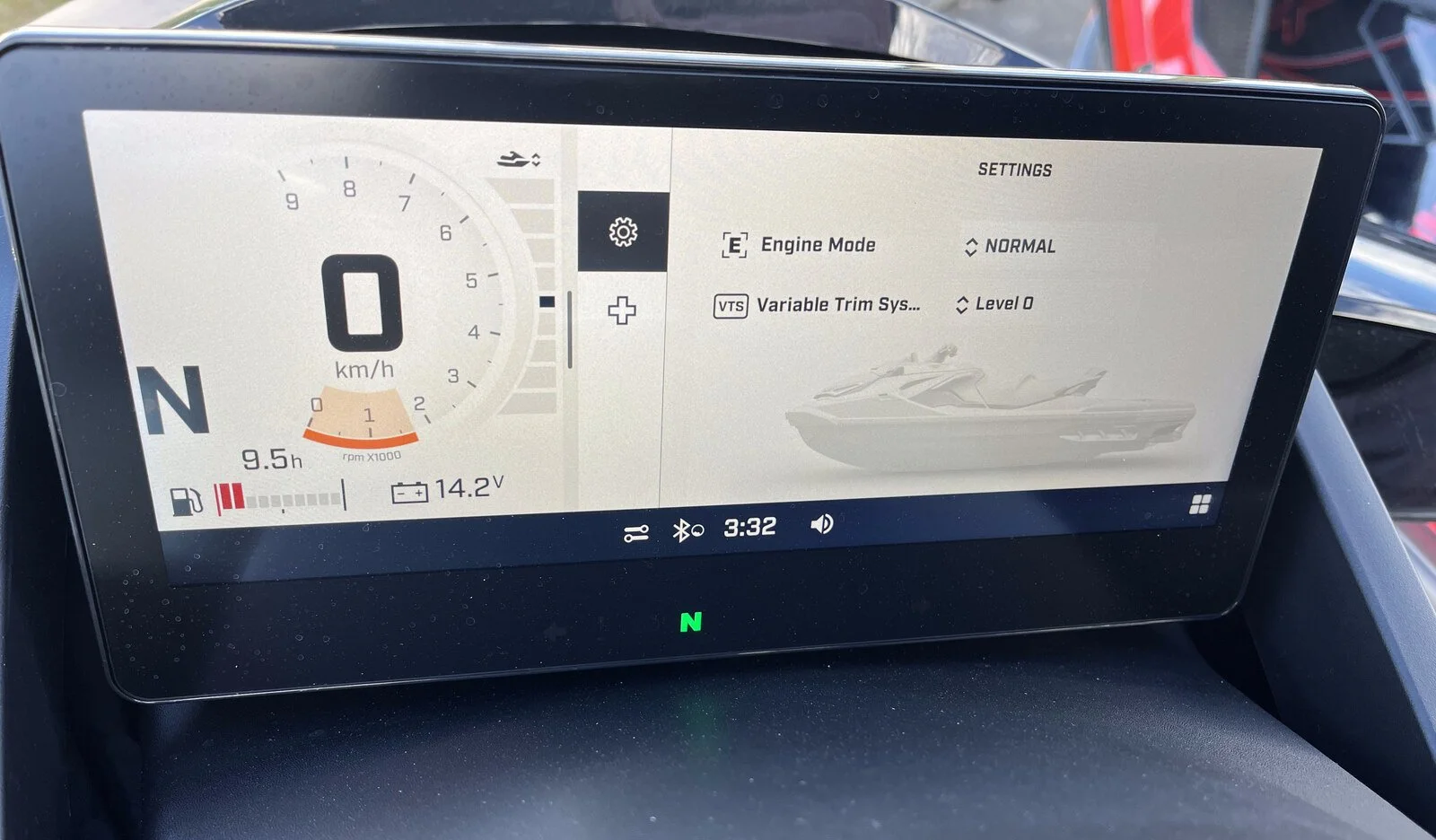
Dash resets or flickers when the starter engages — Voltage is sagging under load.
Low-voltage warnings or cluster fault codes — Battery or charging system isn’t keeping up.
Ski starts fine after sitting on the trailer, not on the water — Battery isn’t holding enough charge to turn over the motor under load in the water.
A battery that’s genuinely failing and one that’s simply flat from poor storage habits look identical from the seat. The difference matters for your wallet — one is a $200 fix, the other is free once you change the habit.
Why Lithium Doesn’t Suit a Sea-Doo
Lithium has plenty of genuine advantages on other vehicles — we don’t need to relitigate all of them here. On a Sea-Doo specifically, here’s why we don’t recommend it as the main battery:
The onboard BMS (battery management system) built into every lithium battery — handling voltage control, thermal regulation and short-circuit protection — is another electronic circuit that isn’t designed for a marine environment, let alone a saltwater one. The battery sits low in the hull, exactly where it’s most exposed to water splash, and it’s under constant vibration the whole time you’re riding.
When a lithium BMS senses a problem, it protects itself by cutting power quickly — which can leave you with no warning and no start. An AGM battery’s voltage drops off gradually instead, which is what triggers the low-voltage warning on your dash before it lets you down completely.
The most common issue I actually see: irregular voltage output from the BMS trips ECU fault codes, particularly the voltage-sensitive ones (fuel level, iBR and others). Clearing these properly usually means a trip to a workshop with a diagnostic computer.
Lithium still has a place on a jet ski — an isolated accessory circuit like a trolling motor, running off its own separate charging system, is a legitimate use case. As the primary battery running your ski’s electronics, we don’t recommend it.
Going Further: Diagnosing Electrical Issues Properly
A dying battery and a genuine electrical fault can look the same from the seat. If you’re chasing a no-start, a dash that won’t wake up, or a fault code that keeps coming back, that diagnostic process is covered properly in the New Owner Guide and DIY Servicing courses — including how to tell the two apart before you start replacing parts.
Replacing the battery itself is a common, straightforward job once you know the correct cable disconnect order and torque spec — that exact procedure is covered step-by-step in the New Owner Guide course.
Related Articles
Sea-Doo DESS Key Explained: Programming, Problems & Replacement
Sea-Doo Fault Codes: Full List, Plain-English Explanations & What To Do
How Many Hours Is Too Many on a Used Sea-Doo?